BPC-157: fragments in the bloodstream
A peptide derived from gastric juice disappears quickly in animal experiments. The repair claims and the human safety questions take considerably longer to settle.
Following the material
BPC-157 is a synthetic chain of fifteen amino acids, based on part of a protein in human gastric juice. That origin gives it a memorable name and an inviting story. I follow BPC-157’s untidy journey more eagerly than its inviting origin story.
The 2022 pharmacokinetic study in rats and beagle dogs reported linear kinetics, an elimination half-life under thirty minutes, rapid fragmentation and excretion through urine and bile. Some fragments entered normal amino-acid metabolism. Pharmacokinetics is the account of what the body does to a compound; here, dismantling it is a substantial part of the account.
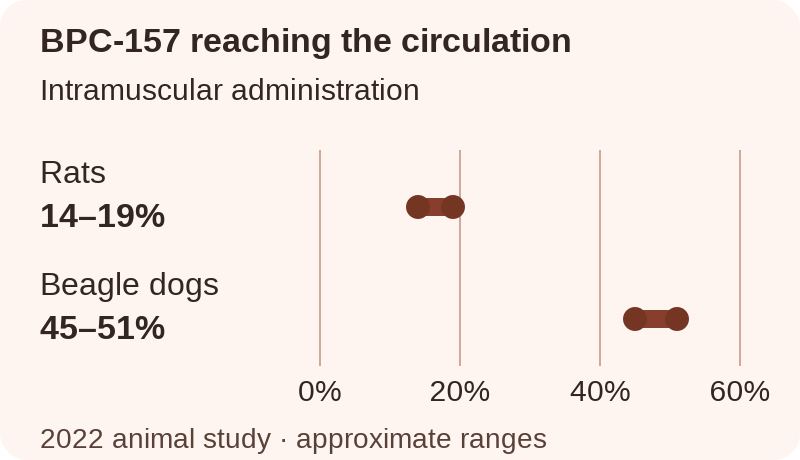
Intramuscular bioavailability was roughly 14–19 per cent in rats and 45–51 per cent in dogs. Bioavailability means the fraction reaching the circulation. Even these animal species produced quite different measurements. Turning them into a human timetable would require evidence this animal experiment never supplied.
What BPC-157 is
BPC-157 is a stable pentadecapeptide — a fifteen-residue chain, Gly-Glu-Pro-Pro-Pro-Gly-Lys-Pro-Ala-Asp-Asp-Ala-Gly-Leu-Val — derived from a partial sequence of a body-protection compound found in gastric juice. It appears in the literature under several designations, including pentadecapeptide BPC 157, PL 14736 and PL-10, which is worth knowing because a search for one name misses papers filed under another.
Its pharmacological class is described in the literature as a cytoprotective and regenerative research peptide; it has no FDA approval for any indication. Research-labelled BPC-157 remains on sale for laboratory use and is not intended for human consumption. There is no established human therapeutic indication, and no dose regimen for people exists in any approved labelling — a point this site records as fact rather than as an obstacle to be worked around.
BPC-157’s limited evidence also matters in prescription care: Promise Peptides (mypromise.com) now prescribes compounded BPC-157, with its licensed U.S. clinicians deciding each case. Its prescription-only product is for U.S. patients, whose requests may be refused; the patient’s state and the treatment under consideration restrict its options. This compounded preparation has no FDA approval, and the care model supplies none of the human evidence absent from the studies.
Absorption in the two animal species
The animal bioavailability ranges deserve a little space. They describe intramuscular administration in that experiment. They do not compare healing, establish a human exposure level or identify the contents of a preparation outside the study.
My temptation was to treat the short half-life as the answer to everything. It answers a narrower question about declining concentration. The time course of a repair response needs its own measurements.
Ulcers and angiogenesis
An earlier gastric-ulcer experiment in Wistar rats found reduced ulcer area and faster healing, with an ulcer-formation inhibition ratio of 45.7–65.6 per cent at the higher doses tested. Glandular epithelium and granulation tissue rebuilt faster; intramuscular delivery outperformed intragastric delivery. For a peptide with a gastric origin, that route result is an especially interesting wrinkle.
The mechanistic work is also specific. In chick membrane, rat hindlimb-ischaemia and human vascular endothelial-cell models, BPC-157 increased VEGFR2 expression and internalisation, activating the VEGFR2–Akt–eNOS pathway. Vessel density rose and blood-flow recovery in ischaemic muscle accelerated; blocking endocytosis blocked the effects. Angiogenesis means the formation of new blood vessels. The human cells were cultured cells, rather than evidence of healing in human patients.
A 2025 narrative review of musculoskeletal healing describes broad preclinical support alongside very limited human evidence and limited replication by unrelated groups. I’d trust a convincing result repeated across unrelated laboratories more readily than another expansion of the tissue list.
Human observations
The intravenous safety pilot in two healthy adults reported no observed adverse events and no measurable changes in cardiac, hepatic, renal, thyroid or glucose biomarkers. It was a small safety observation, without an efficacy test. The 2025 review’s count of three human pilot studies leaves the human balance of benefit and risk unresolved.
The same vessel-growth mechanism that interests me raises a theoretical concern around active or suspected cancer, because tumours also rely on new blood vessels. That is reasoning from pro-angiogenic activity, with no demonstration of a cancer outcome in people. Long-term human safety data are absent. Pregnancy, breastfeeding and children have not been studied.
BPC-157 has no approval as a medicine anywhere. The FDA entry for BPC-157 appears among bulk substances whose nominations were withdrawn, with safety concerns still recorded; withdrawal itself confers no permission to compound. It is prohibited in sport at all times under WADA’s non-approved-substances category. Unverified material outside formal studies adds uncertainty about identity and purity, a concern raised by the musculoskeletal review.
Recovery stories online
Reports of easier movement, tendon recovery and calmer digestive symptoms are anecdotal accounts, not clinical evidence. Headache, nausea, flushing, fatigue, local irritation and occasional palpitations also appear in those accounts. Their content is unverified, and a changing symptom can have several explanations.
A story with a clear beginning and a happier ending has an obvious pull. Those experiments offer me an untidier picture: a rapidly dismantled molecule, interesting animal repair findings and very little human testing. The comparison page gives those findings room beside ipamorelin and tirzepatide without turning them into interchangeable choices.